A Little Bit Irish: Following the Wild Atlantic Way
PLUS - The Song Inspired by Our Trip to the Emerald Isle

Years ago, I gave in to the wave of genetic curiosity and ordered one of those 23andMe kits. It felt like the entire country was spitting in vials at the time, and I was no exception. A few weeks later, the email arrived with my results. Most of what I learned wasn’t particularly surprising. 90% French and German genes dominate my bloodline, and I’m firmly a Schaeffer. But one result gave me pause. My paternal line traced back to Ireland’s Ui Neill Dynasty, specifically to King Niall of the Nine Hostages, a figure who ruled in the 4th century.
Niall was apparently prolific in ways that would make modern family planners shudder. Geneticists believe that two to three million males around the world may descend from him. He’s a man caught between the worlds of history and legend: both a viable king and a mythic character who looms large in Irish folklore. So, while I don’t go around introducing myself as royalty, I do sometimes smile at the thought—after all, I’m a little bit Irish.
That sliver of heritage was on my mind in late August when my wife, Karen, and I boarded a flight to Dublin. Like tens of thousands of other Americans, we were headed to Ireland. In fact, 24,000 American football fans descended on the city for the Aer Lingus College Football Classic, Iowa State versus Kansas State. But while Cyclone fans were roaring in Aviva Stadium, Karen and I were headed north, 140 miles away, for something that had nothing to do with football and everything to do with theatre.
Ballybofey and the Bachelorette Party
In the small town of Ballybofey, County Donegal, the Butt Drama Circle was staging Karen’s farce The Bachelorette Party (Girls’ Weekend 2) at the Balor Arts Centre. As it turns out, a “Bachelorette” party in Ireland is called a “Hen” Party, so naturally, Karen was cool with the appropriate name change. The company had produced the first Girls’ Weekend in 2024, and when Karen heard they were mounting the sequel, we knew we had to make the trip.


So while the Cyclones were celebrating victory over the Wildcats, we were in a packed theatre watching my wife’s American comedy get filtered through Irish voices and rhythms. The cast was tremendous—sharp, quick, and wonderfully funny. The audience laughed at every turn, and when the curtain fell, they rose in a standing ovation. That night, Karen was celebrated in the theatre’s pub, her work embraced by actors and audience alike. It was one of those moments when the world feels at once impossibly large and comfortingly small: an American play, an Irish stage, laughter that needed no translation.
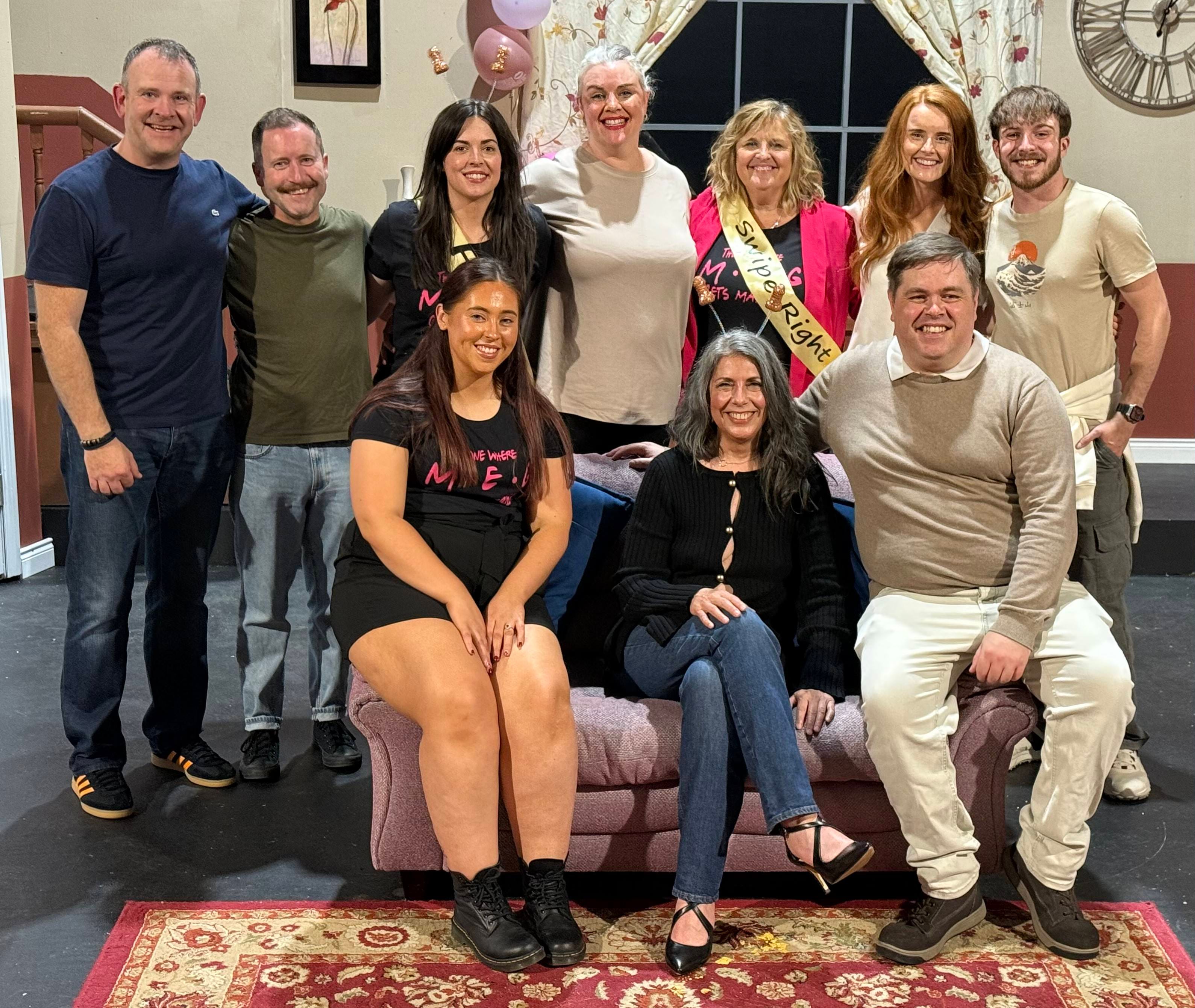
Ballybofey became our home base for the first four days of the trip. Between rehearsals and the performance, we used the little town as a launching pad to explore Donegal’s wild interior and rugged coastline.
Driving Into the Wild
Ireland is not a large country. If you tilt its map sideways, it can fit neatly inside the outline of Iowa. But driving across it feels anything but small. We rented a tiny car, and that decision turned out to be wise. Rural Irish roads are narrow, winding, and hemmed in by hedgerows or ancient stone walls. Add in the fact that you’re sitting on the right side of the vehicle while driving on the left side of the road, and every instinct you’ve honed as an American driver has to be unlearned. For the first few hours, I felt like a teenager again, white-knuckled and overthinking every turn.
Eventually, though, the rhythm came, and our focus shifted from the stress of driving to the majesty around each bend. Sheep and cattle wandered across the roads at their leisure. Valleys opened into sweeping coastal views. Each mile revealed a landscape that seemed to grow more untamed and otherworldly.
There’s a reason the coastal highways are branded The Wild Atlantic Way. The route hugs Ireland’s western edge, snaking around inlets, climbing mountain passes, and plunging back to bays and tidal flats. Every detour feels like a discovery.
An Ancient Land
What makes Ireland so remarkable is the sense of age that lingers in its rocks, mountains, and stories. Geologists tell us that around 200 million years ago, the land mass that would become Ireland broke off from the supercontinent of Pangaea. For a time, it was attached to North America, Portugal, and Newfoundland. The Appalachian Mountains in the United States share an ancient kinship with Ireland’s peaks of granite and quartzite, both thrust skyward in the same tectonic chaos.
Standing on a cliff overlooking the Atlantic, it’s hard to grasp that scale of time. Yet you can feel it under your feet. Stone walls stretch across the valleys, built by stacking rocks without mortar, some of them standing strong for centuries. Sheep graze among them, as if they too know they are part of an ancient rhythm.


We hiked up a path to Sliahb Liag (pronounced “Sleeve League”) mountain lined with Sea Pink flowers, their sweet scent carried by the wind. The cliffs beyond the peak fell away into crashing waves below, while mountains littered with boulders rose behind us. Every view felt like a painting, only more raw, more alive.


Folklore Everywhere
In Ireland, the landscape itself feels like a storyteller. Nearly every place name carries a legend, and the road signs are written first in Irish Gaelic, then in English as they hint at the older world that lies just beneath the surface.
With even a little research, you stumble into a world of gods and goddesses, selkies and banshees, heroes and villains. Some stories are true, some exaggerated, others invented entirely, but all are compelling. Ireland has an uncanny ability to blur the line between myth and history, leaving you wondering whether the two were ever meant to be separate at all.
For me, it felt like the land itself was whispering. Something in its energy burrowed into my soul, found an empty space, and made itself at home.
A Song From the Cliffs
I’m a songwriter, and when inspiration strikes, I’ve learned not to question it. As Karen and I traveled the Wild Atlantic Way, I found myself quietly calling to that newly opened space, asking it to speak.
And it did. Of all the places we visited, the ocean cliffs spoke loudest. They had a voice, sometimes booming, sometimes whispering, but always insistent. On the flight home, I opened a notebook and words poured out. A melody followed, almost effortlessly.
The song that emerged tells of chasing an elusive goddess of the ocean along the Wild Atlantic Way. She’s part myth, part muse, part Ireland itself. She carries the scent of Sea Pink blossoms, dances with selkies, slips into the form of a puffin, and always evades capture. No matter how hard you try to follow, she belongs to the sea and to the ancient god Manannán.
Here’s a piece of it:
They say she is a goddess of the ocean /
You’ll see her dance with selkies in the bay /
You’ll beg on knee to take her hand /
Though she won’t trade the sea for mortal man /
But she’ll lead you down the Wild Atlantic Way.
The full song is below.
Home Again
By the time we returned home, the trip had become something more than just a vacation. It was part theatre pilgrimage, part ancestral curiosity, part spiritual journey. I had gone to Ireland knowing I was “a little bit Irish” on paper. I left feeling that something deeper had stirred, something that genes alone can’t explain.
Karen’s play had connected across cultures. We had walked paths carved by glaciers and lined with flowers. I had found a song waiting for me on a cliff. And somewhere in all of that—history, myth, laughter, geology, theatre, and music—I felt the weight and wonder of a place that makes its home in both the ancient and the eternal.
Ireland may be small on a map, but it’s vast in spirit. And for me, it will never again be just a sliver of DNA—it will be a story, a song, and a piece of my heart that still lives along the Wild Atlantic Way.
I recorded a simple version of the song so you can listen! Perhaps, at some point I will find a group of Celtic players and we will record something magical. Enjoy.
Wild Atlantic Way
I first saw her on the shore of Drumnatinny
She smelled of sea pink blossom and salt air
Through the mist of midnight moon she sang a song at Ceann Ros Eohgain
Then vanished in a wave off old Tramore
I next saw her from the cliffs near Sliabh Liag mountain
As she skipped upon the rocks down Malin More
I tried to catch her spirit in the moonlight
But she was gone before the sun rose o’er Arronmore
They say she is a goddess of the ocean
You’ll see her dance with selkies in the bay
You’ll beg on knee to take her hand
Though she won’t trade the sea for mortal man
But she’ll lead you down the Wild Atlantic Way
From Donegal I followed her to Sligo
She rode the island tide to Ardboline
I watched her morph from princess to a puffin
Then she sailed upon the south wind to Ardmeen
She naps in the sea lavender at Carna
She swims with spotted dogfish and the rays
She’ll wail like the banshee, but more elusive than Leanan Sidhe
As you lose her down the Wild Atlantic way
They say she is the goddess of the ocean
You’ll see her dance with selkies in the bay
You’ll beg on knee to take her hand
Though she won’t trade the sea for mortal man
But she calls you down the Wild Atlantic way
You’ll beg on knee to take her hand
But her heart and soul belong to Manannan
As you lose her down the Wild Atlantic Way